Update 18 oktober 2026: Deze site gaat over een maand offline.
Alle informatie zal dan hier te vinden zijn: https://www.hilding.nl/lfn3
Participeren
Je kunt onafhankelijk aan dit onderzoek deelnemen door een Oura Ring te gaan dragen tijdens je slaap, een smartring, eerst enkele maanden op een locatie in de buurt van windmolens en daarna enkele dagen, weken of maanden op een plek waar weinig windmolens staan, zoals bijvoorbeeld het Eifelgebied, Luxemburg, of de Belgische Ardennen.
Bestel eerst de maatset en kies een formaat ring die comfortabel om je linker middelvinger past. Het is een forse ring, dus je kunt 'm het beste om je middelvinger dragen. Ter afwisseling kun je 'm dan ook om je rechter ringvinger dragen. (Of andersom als je linkshandig bent.)
Het Ardennen-experiment
Hebben de laagfrequente trillingen van windmolens een verstorende invloed op de laagfrequente hersengolven die optreden tijdens de diepe slaap? Zo ja, in welke mate?
Als het zo is dat deze trillingen via bijvoorbeeld hersengolfsynchronisatie een onderdrukkend effect hebben op de diepe slaap (de N3 fase van de slaapcyclus), is het dan wel acceptabel om windmolens 's nachts te laten draaien in de nabijheid van woningen? Wat kan hierbij als "nabij" aangemerkt worden (hoe ver reiken deze trillingen)?
Wat gebeurt er als een proefpersoon enkele maanden nabij een windmolenpark slaapt en daarna enkele weken of maanden in een "windmolenvrij" gebied, zoals bijvoorbeeld de Belgische Ardennen? Neemt het percentage diepe slaap dan toe? Neemt het aantal minuten diepe slaap toe?
Update (26 april 2026): Ik heb een nieuw verblijf in de Mirador hut geboekt. Dit keer ga ik er niet drie nachten slapen maar twaalf nachten, plus nog drie nachten in een tent op een ander gedeelte van natuurcamping Le Pouhou. Deze Ardennen-vervolgstudie zal begin juli plaatsvinden. Ik blijf loggen (zojuist log #110 toegevoegd). De gemiddelde hoeveelheid diepe slaap (N3) sinds mijn terugkeer in Bellingwolde, nabij Windpark Rhede en Windpark N33, is 50 minuten per nacht. Dat is lager dan in de 84 nachten voorafgaand aan het eerste Ardennen-experiment, want dat was 56 minuten diepe slaap per nacht. Het record sinds mijn terugkeer was 79 minuten (afgelopen nacht), terwijl dat vóór het Ardennen-experiment 92 minuten was geweest. Het gemiddelde is lager omdat er verhoudingsgewijs veel slechte nachten tussenzaten: een nacht van 24 minuten, een van 23 minuten, een van 38 minuten en een van 29 minuten eN3).
Ter vergelijking: in de Mirador hut was mijn gemiddelde 90 minuten eN3, het record 105 minuten eN3, en de slechtste score 78 minuten (2 minuten meer dan het record van de twintig nachten sinds mijn terugkeer). Helaas kon ik rond het paasweekend maar drie nachten in de Mirador slapen. In juli keer ik daarom terug voor een langer verblijf, om te zien of de hoge slaapscores ook langere tijd aanhouden.
Hoeveel diepe slaap is normaal? Vaak wordt gesteld dat een volwassene gemiddeld 90 tot 120 minuten diepe slaap per nacht nodig heeft, en dat de diepe slaap normaliter 15 tot 25% van de totale slaapduur in beslag neemt. Wat hierbij als absolute minimum vereist is voor het behoud van een goede hersengezondheid (60 minuten? 55 minuten?), dat is op dit moment nog niet bekend.
Belangrijke update (14 april 2026): Het al in november geplande experiment in de Belgische Ardennen heeft een week geleden plaatsgevonden en het was, ondanks de korte duur, een aanmoedigend succes. De eerste nacht van mijn verblijf in de Mirador hut op natuurcamping Du Pouhou leverde een diepe slaap op van 105 minuten, 13 minuten meer dan mijn record in Bellingwolde (92 minuten) en 49 minuten meer dan het gemiddelde in Bellingwolde (56 minuten). Het gemiddelde in de Mirador was 90 minuten per nacht, dus 34 minuten meer dan het gemiddelde van Bellingwolde.
Deze getallen bewijzen uiteraard niets, want daarvoor is het aantal van 3 nachten simpelweg te laag. De scores moedigen enkel aan om naar de Mirador of een soortgelijke locatie terug te keren om het aantal nachten te verhogen naar ten minste 15 nachten en idealiter 90 nachten.
Heb je de mogelijkheid om bij te dragen aan de realisatie van dit doel, en gerelateerde doelen zoals de ontwikkeling van een permanent slaaplaboratorium in de Ardennen? Steun dan dit project.
Hieronder de brief die ik gisteren aan verschillende professoren en andere academici heb gestuurd:
N3 sleep – slow-wave sleep – deep sleep (eN3) – polysomnography (PSG) – wind turbine infrasound – low-frequency acoustic fluctuations – brainwave entrainment – amplitude modulation – glymphatic clearance – within-subject longitudinal design – sleep architecture – environmental noise exposure – WiTNES Study – real-world ecological validity– in situ citizen science – wearable sleep tracking (Oura Ring) – multi-device sleep tracking – Z-weighted sound pressure measurement – spectrum analysis
I am writing this letter in English so that if you so wish, you can easily share it with international students and colleagues. Feel free to reply in Dutch.
The purpose of this letter is to inform you about the first results of my pilot study covering 90 nights in Bellingwolde (a village in Groningen that is surrounded by nearby wind farms) and 6 nights in the Belgian Ardennes (much fewer turbines around and a significantly lower sound pressure level).
In a within-subject comparison, the average estimated deep sleep in my rural home in Bellingwolde was 56 minutes, whereas during three nights in a secluded cabin in the Ardennes it reached an average of 90 minutes (so 34 minutes higher), with a peak value of 105 minutes, which is 13 minutes higher than the peak value in Bellingwolde (92 minutes), and 21 minutes higher than the second-highest value recorded there (84 minutes).
Despite limitations, the dataset is unusually consistent in format and within-subject longitudinal structure, and these preliminary findings may merit further investigation using polysomnography and a larger sample size. I am reaching out for feedback, supervision, and collaboration.
For quick reference, the key findings are summarized in the THE RESULTS section below. Full context and methodology precede it.
I am also sharing this letter with:
Prof. dr. Peter Meerlo
Prof. dr. Rolf Fronczek
Prof. dr. Robbert Havekes
Staff of the Donders Institute for Brain, Cognition, and Behaviour

The Mirador cabin
The reason I traveled to the Ardennes - booking a cabin three months in advance - is that, contrary to Bellingwolde and the provinces of Groningen and Drenthe in general, there are hardly any wind turbines there. Camping du Pouhou has just 5 Nordex turbines at a distance of 16–18 km, in Sainte-Ode. My home in Bellingwolde has 23 German turbines (of various types) at a distance of 1–3 km, and dozens of Dutch and German turbines in a 20 km radius, with hundreds more in a slightly wider but still influential radius (e.g. Eemshaven, Delfzijl).
I think it's important to address the following first:
- This is not a request for medical advice. I'm not a patient.
- This letter doesn't claim proof. It presents a preliminary working hypothesis alongside observational data.
- I'm not an activist. Although the subject matter of wind turbines is politically charged, I'm not part of any activist group, nor have I been motivated by any political ideology. I'm a drugstore professional (Pharmacon Vakdiploma Drogist, 2001) with a lifelong interest in neuroscience, psychology, and health optimization through nutrition and exercise. Naturally, when I first heard about the glymphatic system, I was immediately fascinated.
- I have carefully reviewed the WiTNES study (Smith et al., Sleep, 2020) and related laboratory and field research on wind turbine noise and sleep. The strengths of these studies (particularly the use of controlled polysomnography) and their weaknesses (limited number of nights or even single-night exposure, artificial sound simulation, and SPL measurements in A-weighting) directly informed my emphasis on long-term within-subject longitudinal data collected in situ with consistent wearable tracking (Sleep Cycle, Fitbit, and Oura), and Z-weighted sound measurements with simultaneous spectrum analysis.
- I'm fully aware of the limitations of citizen science, of my own training, of my low-budget equipment, of the small number of participants (n=1), of the small number of nights at the control location (n=6 or n=3), and the fact that I'm both the participant and the researcher. I've tried to recruit additional participants in my area, but again and again people declined.
- I'm fully aware of all the common pitfalls of research, and potential sources of bias, such as placebo and nocebo effects, confounders, variables, measurement artifacts, and confirmation bias.
- From the very beginning of this research project it has been my aim to get academics and professional equipment (PSG) involved, or to even hand over the entire project to a relevant university department. For example: I'd love to see the Donders Institute expanding upon my methodology.
- I'm fully aware that only PSG can determine N3. That's why I use the term eN3 instead, and keep reaching out to academics for collaboration.
- In this letter I'll focus on the eN3 values, leaving aside the sound and wind data I logged. In a nutshell though it can be stated that sound pressure levels, measured in Z-weighting using a calibrated miniDSP UMIK-1 measuring microphone, tend to fluctuate - in the autumn and winter - between 52 and 75 dB(Z) in my home in Bellingwolde, and between 49 and 52 dB(Z) in the Mirador cabin.
- I've used three different sleep trackers simultaneously, and I started numbering the logs when I purchased the third (most reputable) one: 1) Sleep Cycle, in microphone mode, 2) the Fitbit Charge 6 smartwatch, 3) the Oura Ring Gen 4.
- I'm 51 years old.
THE HYPOTHESIS
This is the hypothesis I formulated in December 2025:
Working hypothesis (mechanistic):
N3 sleep is characterized by slow-wave brain activity (delta waves, approximately 0.5–4.5 Hz). Environmental acoustic phenomena associated with wind turbines—such as low-frequency pressure fluctuations and amplitude modulation—may operate on comparable temporal scales.
It is therefore hypothesized that such external rhythms could, in theory, interact with intrinsic slow oscillations during N3, potentially influencing the stability or continuity of deep sleep. Possible mechanisms include phase interference or forms of entrainment, although these remain theoretical in this context.
If such interactions occur, one might expect:
- Reduced or more fragmented eN3 (estimated deep sleep) during exposure to specific acoustic patterns;
- Systematic differences in eN3 between environments with differing acoustic profiles.
Limitations:
The observations of my research rely on estimated N3 (eN3) derived from wearable devices rather than polysomnography (PSG), and therefore cannot directly confirm sleep stage transitions or underlying neurophysiological mechanisms. My main concern has to do with the glymphatic system (with the release of human growth hormone being a secondary concern), but I have no means to study that system directly.
Broader context:
Given the established role of N3 sleep in restorative processes, including glymphatic clearance, any persistent disruption of deep sleep could have broader physiological implications. However, such implications remain speculative and are beyond the scope of the present observations. Further investigation under controlled conditions, ideally using PSG, would be required.
WHY I HAD TO GO TO THE ARDENNES
I conducted exploratory sound measurements across multiple regions in the Netherlands (Zuid-Holland, Noord-Holland, Utrecht, Gelderland, Overijssel, Flevoland, Drenthe, Friesland, Groningen). Across these locations, I consistently observed low-frequency spectral patterns that I associated with wind turbine activity.
In order to identify a comparative environment with reduced exposure, I selected Camping du Pouhou in the Belgian Ardennes, where the density of wind turbines is lower and distances to installations are greater. The nearest turbines (5 Nordex models, Sainte-Ode) are located at approximately 16–18 km distance.
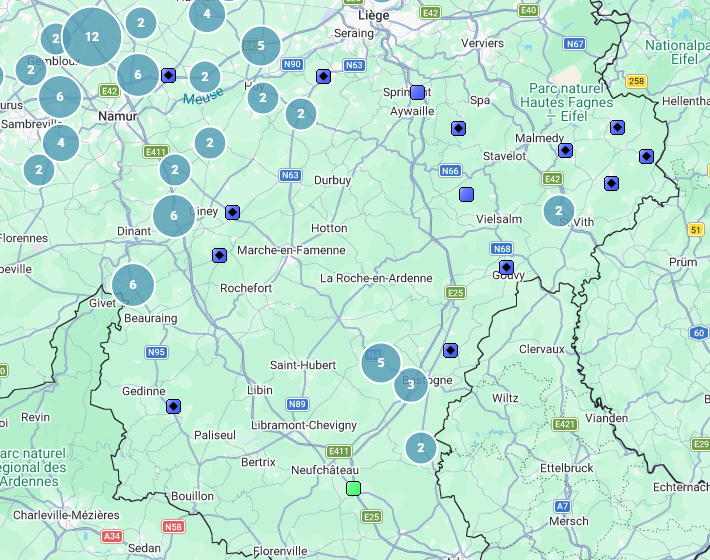
By contrast, my home in Bellingwolde is situated within 1–3 km of multiple wind turbines, with additional installations present within a wider radius.
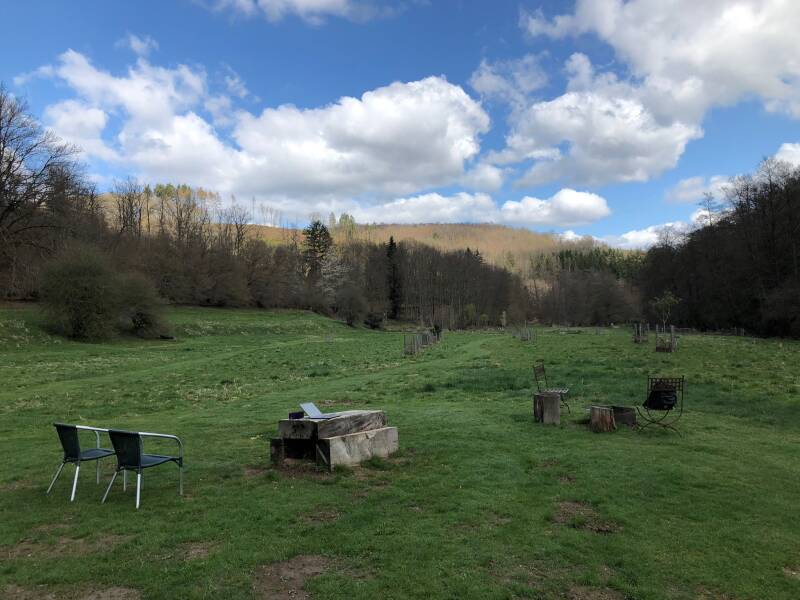
Camping du Pouhou therefore served as a preliminary control environment for this pilot study. Within this location, I made a further distinction between two sleeping environments: a more exposed cabin near a road (Hut van Leon), and the more secluded Mirador cabin, located deeper within the terrain.
For the purposes of this initial experiment, this setup provided a practical means of comparing sleep outcomes across environments with differing acoustic characteristics.
THE RESULTS
The key observations are as follows.
The average eN3 according to Oura (in my estimation the most reliable sleep tracker):
Bellingwolde: 56 minutes
Camping du Pouhou: 70 minutes
- Hut van Leon: 51 minutes
- Mirador: 90 minutes
The mean eN3 duration in the Mirador cabin (n=3) was 34 minutes higher than in Bellingwolde (n=90). While the sample size is small, the magnitude of this difference is notable in a within-subject framework. I intend to return to this cabin, or a similar location, as soon as possible to increase the sample size.
Another way to look at the eN3 scores is to categorize them as follows.
Bellingwolde:
3 x 20-29 minutes
11 x 30-39 minutes
14 x 40-49 minutes
27 x 50-59 minutes
16 x 60-69 minutes
14 x 70-79 minutes
4 x 80-89 minutes
1 x 90-99 minutes
As you can see, the peak of the bell curve is between 50 and 59 minutes of eN3. The average of 56 minutes falls within this range, as the outliers have been few. The bulk of the eN3 scores has been between 40 and 79 minutes.
When we do the same for Camping du Pouhou (both cabins), we get this list:
1 x 20-29 minutes 1 x 50-59 minutes 1 x 60-69 minutes 1 x 70-79 minutes 1 x 80-89 minutes 1 x 100-109 minutes
You may wonder why there is an outlier of 20-29 minutes. That was my first night in the Hut van Leon. I woke up several times because of lorries passing by the campsite. All figures from the lower spectrum pertain to my nights in the Hut van Leon. Despite the physical comfort, my sleep scores remained unimpressive.
Here are the sleep scores in chronological order:
Night 1, Hut van Leon: 28 minutes
Night 2, Mirador: 105 minutes
Night 3, Mirador: 87 minutes
Night 4, Mirador: 78 minutes
Night 5 (Easter*), Hut van Leon: 58 minutes
Night 6 (Easter*), Hut van Leon: 67 minutes
* Easter is relevant because many people arrived at the campsite and stayed up late, and also my girlfriend joined me in the cabin, though sleeping in a different bed. For various reasons, the Mirador nights were most suited for my experiment, and the results seem to reflect this.
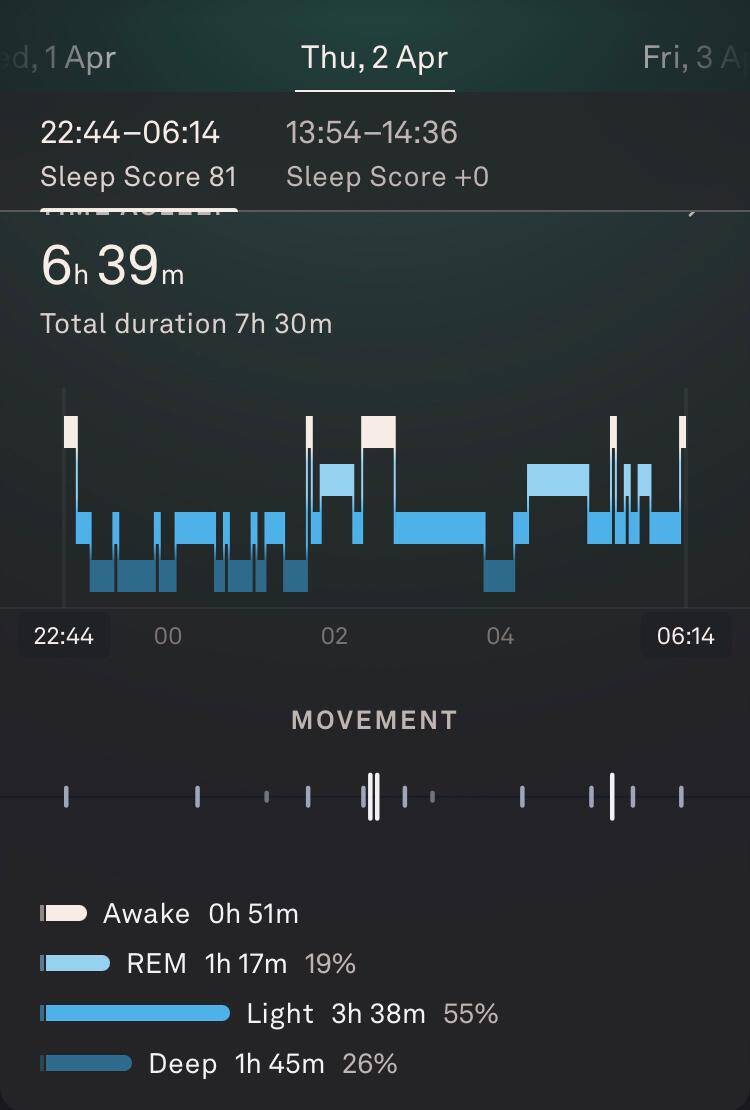
It's fair to point out that the 105 minute night followed a 28 minute night, suggesting my brain made up for the previous night. However, in Bellingwolde, nights of 25 to 35 minutes were never followed by record-breaking eN3 scores. I've observed my body catch up on hours of total sleep, but never impressively or consistently on low eN3 specifically. The total duration of my sleep that first night at the Hut van Leon was exactly the 6 hours and 47 minutes that Oura has recommended for me, based on its 30 day calibration, and the record-breaking first night in the Mirador cabin was only slightly shorter (6 hours and 39 minutes).
Now let's look at my personal records (my top 3) in Bellingwolde versus those in the Ardennes.
The highest eN3 score I ever got in Bellingwolde was 92 minutes.
The highest eN3 score I got in the Ardennes was 105 minutes.
The second highest eN3 score I ever got in Bellingwolde was 84 minutes (which occurred twice).
The second highest eN3 score I got in the Ardennes was 87 minutes.
The third highest eN3 score I got in Bellingwolde was 81 minutes (which occurred once).
The third highest eN3 score I got in the Ardennes was 78 minutes.
That record 105 minutes of eN3 on my first night in the Mirador cabin isn't just 13 minutes higher than my Bellingwolde record of 92 minutes, but also 49 minutes above my Bellingwolde average of 56 minutes. I believe this merits further investigation.
Although I can retrieve all the eN3 percentages of total sleep for my Bellingwolde nights, within the Oura app itself or through my daily screenshots of the hypnograms, I have not written them down yet. But they tend to fluctuate between 10 and 20%, with 14% being a very common figure. In the Mirador cabin however, the figures were 26%, 23%, and 21%.
On all three nights, the eN3 was heavily front-loaded, which is not unusual, but what struck me as astonishing was the virtually uninterrupted nature of this front-loading. I had never seen such an impressive amount of eN3 before, apparently skipping the REM phase entirely to immediately return to the N3. Below I share a screenshot of Oura's hypnogram of that first night in the Mirador cabin. The hypnograms of the other two nights there look virtually the same.
Given the within-subject design, the above differences cannot be attributed to inter-individual variability, but may reflect environmental or contextual factors.
Because of the encouraging first results, I will continue logging, and try to book a much longer stay in the Ardennes, or perhaps in Luxembourg, in the months ahead. Establishing a (semi)permanent sleep lab in a concrete building there, with PSG, class-1 sound meters, and blood analysis (cortisol etc.), could be a fruitful endeavor.
I would greatly appreciate your feedback on the methodology and findings, and would welcome any opportunity for collaboration (with you or your students), supervision, or guidance on how to develop this into a more rigorous study.
Kind regards,
Ivar Verploegh
[...] Bellingwolde
Uit de bijlage, Longitudinal Sleep Data, Logs, Averages, and Preliminary Statistics (January 7 – April 12, 2026):
Oura deep sleep (eN3) scores, in minutes:
Log #1, January 7, 2026, in Bellingwolde, minutes of eN3: 27
Log #2, January 8, minutes of eN3: 37
Log #3, January 9, minutes of eN3: 32
Log #4, January 10, minutes of eN3: 45 (plus a 28 min eN3 nap)
Log #5, January 11, minutes of eN3: 27
Log #6, January 12, minutes of eN3: 77
Log #7, January 13, minutes of eN3: 81
Log #8, January 14, minutes of eN3: 59 (plus a 40 min eN3 nap)
Log #9, January 15, minutes of eN3: 36
Log #10, January 16, minutes of eN3: 59 (plus a 13 min eN3 nap)
Log #11, January 17, minutes of eN3: 67 (plus a 28 min eN3 nap)
Log #12, January 18, minutes of eN3: 33 (plus a 35 min eN3 nap)
Log #13, January 19, minutes of eN3: 63
Log #14, January 20, minutes of eN3: 64
Log #15, January 21, minutes of eN3: 54
Log #16, January 22, minutes of eN3: 49 (plus a 25 min eN3 nap)
Log #17, January 23, minutes of eN3: 52
Log #18, January 24, minutes of eN3: 51 (plus a 28 min eN3 nap)
Log #19, January 25, minutes of eN3: 46 (plus a 24 min eN3 nap)
Log #20, January 26, minutes of eN3: 37 (plus a 37 min eN3 nap)
Log #21, January 27, minutes of eN3: 44
Log #22, January 28, minutes of eN3: 39
Log #23, January 29, minutes of eN3: 74
Log #24, January 30, minutes of eN3: 47
Log #25, January 31, minutes of eN3: 62
Log #26, February 1, minutes of eN3: 39
Log #27, February 2, minutes of eN3: 71
Log #28, February 3, minutes of eN3: 35
Log #29, February 4, minutes of eN3: 65
Log #30, February 5, minutes of eN3: 80
Log #31, February 6, minutes of eN3: 36
Log #32, February 7, minutes of eN3: 84
Log #33, February 8, minutes of eN3: 63
Log #34, February 9, minutes of eN3: 65
Log #35, February 10, minutes of eN3: 80
Log #36, February 11, minutes of eN3: 50
Log #37, February 12, minutes of eN3: 52
Log #38, February 13, minutes of eN3: 36
Log #39, February 14, minutes of eN3: 51
Log #40, February 15, minutes of eN3: 77
Log #41, February 16, minutes of eN3: 52
Log #42, February 17, minutes of eN3: 41
Log #43, February 18, minutes of eN3: 62 (plus a 13 min eN3 nap)
Log #44, February 19, minutes of eN3: 92
Log #45, February 20, minutes of eN3: 64
Log #46, February 21, minutes of eN3: 32
Log #47, February 22, minutes of eN3: 78
Log #48, February 23, minutes of eN3: 55
Log #49, February 24, minutes of eN3: 56
Log #50, February 25, minutes of eN3: 41
Log #51, February 26, minutes of eN3: 41
Log #52, February 27, minutes of eN3: 56
Log #53, February 28, minutes of eN3: 59
Log #54, March 1, minutes of eN3: 55
Log #55, March 2, minutes of eN3: 47
Log #56, March 3, minutes of eN3: 62
Log #57, March 4, minutes of eN3: 58
Log #58, March 5, minutes of eN3: 73
Log #59, March 6, minutes of eN3: 52
Log #60, March 7, minutes of eN3: 69
Log #61, March 8, minutes of eN3: 43 (plus a 35 min eN3 nap)
Log #62, March 9, minutes of eN3: 66
Log #63, March 10, minutes of eN3: 57
Log #64, March 11, minutes of eN3: 70
Log #65, March 12, minutes of eN3: 63
Log #66, March 13, minutes of eN3: 70
Log #67, March 14, minutes of eN3: 44
Log #68, March 15, minutes of eN3: 56
Log #69, March 16, minutes of eN3: 40
Log #70, March 17, minutes of eN3: 58 (plus a 23 min eN3 nap)
Log #71, March 18, minutes of eN3: 57
Log #72, March 19, minutes of eN3: 72
Log #73, March 20, minutes of eN3: 84
Log #74, March 21, minutes of eN3: 50
Log #75, March 22, minutes of eN3: 43
Log #76, March 23, minutes of eN3: 73
Log #77, March 24, minutes of eN3: 50
Log #78, March 25, minutes of eN3: 41 (plus an 11 min eN3 nap)
Log #79, March 26, minutes of eN3: 56 (plus a 19 min eN3 nap)
Log #80, March 27, minutes of eN3: 57
Log #81, March 28, minutes of eN3: 48
Log #82, March 29, minutes of eN3: 39
Log #83, March 30, minutes of eN3: 51 (plus a 6 min N3 nap)
Log #84, March 31, minutes of eN3: 77
Log #85, April 1, in the Hut van Leon cabin, minutes of eN3: 28
Log #86, April 2, in the Mirador cabin, minutes of eN3: 105 (plus a 4 min eN3 nap)
Log #87, April 3, in the Mirador cabin, minutes of eN3: 87 (plus a 4 min eN3 nap)
Log #88, April 4, in the Mirador cabin, minutes of eN3: 78
Log #89, April 5, in the Hut van Leon cabin, minutes of eN3: 58
Log #90, April 6, in the Hut van Leon cabin, minutes of eN3: 67
Log #91, April 7, back in Bellingwolde, minutes of eN3: 69
Log #92, April 8, minutes of eN3: 63
Log #93, April 9, minutes of eN3: 64
Log #94, April 10, minutes of eN3: 59
Log #95, April 11, minutes of eN3: 24
Log #96, April 12, minutes of eN3: 57
Categories and their occurrences:
20-29 minutes eN3 (3 times in Bellingwolde; 1 time in the Ardennes, Hut van Leon)
30-39 minutes eN3 (12 times in Bellingwolde)
40-49 minutes eN3 (15 times in Bellingwolde)
50-59 minutes eN3 (27 times in Bellingwolde; 1 time in the Ardennes, Hut van Leon)
60-69 minutes eN3 (16 times in Bellingwolde; 1 time in the Ardennes, Hut van Leon)
70-79 minutes eN3 (11 times in Bellingwolde; 1 time in the Ardennes, Hut van Leon)
80-89 minutes eN3 (5 times in Bellingwolde; 1 time in the Ardennes, Mirador cabin)
90-99 minutes eN3 (1 time in Bellingwolde; 1 time in the Ardennes, Mirador cabin)
100-109 minutes eN3 (1 time in the Ardennes, Mirador cabin)
Averages:
Bellingwolde 90 night average, naps excluded: 56 minutes
Bellingwolde average, naps included: 60 minutes
Hut van Leon 3 night average, naps excluded: 51 minutes
Hut van Leon average, naps included: 51 minutes
Mirador 3 night average, naps excluded: 90 minutes
Mirador average, naps included: 92 minutes
Bellingwolde record eN3, naps excluded: 92 minutes
Bellingwolde record eN3, naps included: 92 minutes
Mirador record eN3, main sleep only: 105 minutes
Mirador record eN3, naps included: 109 minutes
The averages of the Hut van Leon are slightly worse than the averages of Bellingwolde. The Mirador average exceeds Bellingwolde by 34 minutes and the Hut van Leon by 39 minutes. Simply moving to the Ardennes wasn’t sufficient to improve sleep scores. Only the Mirador cabin provided a sufficiently different environment.
Leaving the Mirador cabin, first back to the Hut van Leon and then back to Bellingwolde, the eN3 scores immediately dropped to ~65 minutes, then to below 60, and even to the exceptionally low 24 minutes. The key structure in the data is therefore:
Home (56) → Hut (51) → Mirador (90) → Home again (~60 → 24 → 56)
The baseline: 84 nights in Bellingwolde preceding the Ardennes experiment.
The experimental location: 3 nights in the Mirador cabin.
The unintended control condition: 3 nights in the Hut van Leon (1 preceding the Mirador nights, 2 following it).
The reversal: 6 nights after returning home in Bellingwolde.
Correlations
Is there a correlation between sound pressure level and minutes or percentages of deep sleep? No, in the 100+ log entries I could not detect a correlation on the basis of decibels in Z-weighting. Sound pressure level doesn't predict how well I sleep, and neither do wind speed or wind direction.
Log #1, January 7, 2026, in Bellingwolde, minutes of eN3: 27
eN3 percentage of total sleep: 9
dB(Z) while falling asleep: 66
Log #2, January 8, minutes of eN3: 37
eN3 percentage of total sleep: 10
dB(Z) while falling asleep: 64
Log #3, January 9, minutes of eN3: 32
eN3 percentage of total sleep: 12
dB(Z) while falling asleep: 58
Log #4, January 10, minutes of eN3: 45
eN3 percentage of total sleep: 17
dB(Z) while falling asleep: 71
Log #5, January 11, minutes of eN3: 27
eN3 percentage of total sleep: 9
dB(Z) while falling asleep: 53
Log #6, January 12, minutes of eN3: 77
eN3 percentage of total sleep: 18
dB(Z) while falling asleep: 68
Log #7, January 13, minutes of eN3: 81
eN3 percentage of total sleep: 23
dB(Z) while falling asleep: 58
Log #8, January 14, minutes of eN3: 59
eN3 percentage of total sleep: 25
dB(Z) while falling asleep: 65
Log #9, January 15, minutes of eN3: 36
eN3 percentage of total sleep: 29
dB(Z) while falling asleep: 57
Log #10, January 16, minutes of eN3: 59
eN3 percentage of total sleep: 28
dB(Z) while falling asleep: 69
Log #11, January 17, minutes of eN3: 67
eN3 percentage of total sleep: 25
dB(Z) while falling asleep: 53
Log #12, January 18, minutes of eN3: 33
eN3 percentage of total sleep: 12
dB(Z) while falling asleep: 58
Log #13, January 19, minutes of eN3: 63
eN3 percentage of total sleep: 25
dB(Z) while falling asleep: 54
Log #14, January 20, minutes of eN3: 64
eN3 percentage of total sleep: 16
dB(Z) while falling asleep: 61
Log #15, January 21, minutes of eN3: 54
eN3 percentage of total sleep: 21
dB(Z) while falling asleep: 58
Log #16, January 22, minutes of eN3: 49
eN3 percentage of total sleep: 23
dB(Z) while falling asleep: 67
Log #17, January 23, minutes of eN3: 52
eN3 percentage of total sleep: 15
dB(Z) while falling asleep: 71
Log #18, January 24, minutes of eN3: 51
eN3 percentage of total sleep: 15
dB(Z) while falling asleep: 70
Log #19, January 25, minutes of eN3: 46
eN3 percentage of total sleep: 16
dB(Z) while falling asleep: 65
Log #20, January 26, minutes of eN3: 37
eN3 percentage of total sleep: 16
dB(Z) while falling asleep: 56
Log #21, January 27, minutes of eN3: 44
eN3 percentage of total sleep: 13
dB(Z) while falling asleep: 54
Log #22, January 28, minutes of eN3: 39
eN3 percentage of total sleep: 11
dB(Z) while falling asleep: 68
Log #23, January 29, minutes of eN3: 74
eN3 percentage of total sleep: 16
dB(Z) while falling asleep: 64
Log #24, January 30, minutes of eN3: 47
eN3 percentage of total sleep: 11
dB(Z) while falling asleep: 65
Log #25, January 31, minutes of eN3: 62
eN3 percentage of total sleep: 18
dB(Z) while falling asleep: 69
Log #26, February 1, minutes of eN3: 39
eN3 percentage of total sleep: 10
dB(Z) while falling asleep: 65
Log #27, February 2, minutes of eN3: 71
eN3 percentage of total sleep: 13
dB(Z) while falling asleep: 68
Log #28, February 3, minutes of eN3: 35
eN3 percentage of total sleep: 12
dB(Z) while falling asleep: 70
Log #29, February 4, minutes of eN3: 65
eN3 percentage of total sleep: 19
dB(Z) while falling asleep: 70
Log #30, February 5, minutes of eN3: 80
eN3 percentage of total sleep: 22
dB(Z) while falling asleep: 65
Log #31, February 6, minutes of eN3: 36
eN3 percentage of total sleep: 14
dB(Z) while falling asleep: 64
Log #32, February 7, minutes of eN3: 84
eN3 percentage of total sleep: 20
dB(Z) while falling asleep: 62
Log #33, February 8, minutes of eN3: 63
eN3 percentage of total sleep: 15
dB(Z) while falling asleep: 58
Log #34, February 9, minutes of eN3: 65
eN3 percentage of total sleep: 17
dB(Z) while falling asleep: 61
Log #35, February 10, minutes of eN3: 80
eN3 percentage of total sleep: 18
dB(Z) while falling asleep: 64
Log #36, February 11, minutes of eN3: 50
eN3 percentage of total sleep: 15
dB(Z) while falling asleep: 55
Log #37, February 12, minutes of eN3: 52
eN3 percentage of total sleep: 13
dB(Z) while falling asleep: 58
Log #38, February 13, minutes of eN3: 36
eN3 percentage of total sleep: 10
dB(Z) while falling asleep: 56
Log #39, February 14, minutes of eN3: 51
eN3 percentage of total sleep: 13
dB(Z) while falling asleep: 57
Log #40, February 15, minutes of eN3: 77
eN3 percentage of total sleep: 21
dB(Z) while falling asleep: 54
Log #41, February 16, minutes of eN3: 52
eN3 percentage of total sleep: 14
dB(Z) while falling asleep: 69
Log #42, February 17, minutes of eN3: 41
eN3 percentage of total sleep: 9
dB(Z) while falling asleep: 57
Log #43, February 18, minutes of eN3: 62
eN3 percentage of total sleep: 18
dB(Z) while falling asleep: 62
Log #44, February 19, minutes of eN3: 92
eN3 percentage of total sleep: 22
dB(Z) while falling asleep: 69
Log #45, February 20, minutes of eN3: 64
eN3 percentage of total sleep: 18
dB(Z) while falling asleep: 70
Log #46, February 21, minutes of eN3: 32
eN3 percentage of total sleep: 9
dB(Z) while falling asleep: 68
Log #47, February 22, minutes of eN3: 78
eN3 percentage of total sleep: 22
dB(Z) while falling asleep: 60
Log #48, February 23, minutes of eN3: 55
eN3 percentage of total sleep: 16
dB(Z) while falling asleep: 62
Log #49, February 24, minutes of eN3: 56
eN3 percentage of total sleep: 14
dB(Z) while falling asleep: 62
Log #50, February 25, minutes of eN3: 41
eN3 percentage of total sleep: 14
dB(Z) while falling asleep: 56
Log #51, February 26, minutes of eN3: 41
eN3 percentage of total sleep: 13
dB(Z) while falling asleep: 64
Log #52, February 27, minutes of eN3: 56
eN3 percentage of total sleep: 14
dB(Z) while falling asleep: 65
Log #53, February 28, minutes of eN3: 59
eN3 percentage of total sleep: 24
dB(Z) while falling asleep: 55
Log #54, March 1, minutes of eN3: 55
eN3 percentage of total sleep: 21
dB(Z) while falling asleep: 64
Log #55, March 2, minutes of eN3: 47
eN3 percentage of total sleep: 15
dB(Z) while falling asleep: 63
Log #56, March 3, minutes of eN3: 62
eN3 percentage of total sleep: 14
dB(Z) while falling asleep: 58
Log #57, March 4, minutes of eN3: 58
eN3 percentage of total sleep: 14
dB(Z) while falling asleep: 59
Log #58, March 5, minutes of eN3: 73
eN3 percentage of total sleep: 18
dB(Z) while falling asleep: 64
Log #59, March 6, minutes of eN3: 52
eN3 percentage of total sleep: 15
dB(Z) while falling asleep: 62
Log #60, March 7, minutes of eN3: 69
eN3 percentage of total sleep: 20
dB(Z) while falling asleep: 50
Log #61, March 8, minutes of eN3: 43
eN3 percentage of total sleep: 15
dB(Z) while falling asleep: 52
Log #62, March 9, minutes of eN3: 66
eN3 percentage of total sleep: 18
dB(Z) while falling asleep: 53
Log #63, March 10, minutes of eN3: 57
eN3 percentage of total sleep: 19
dB(Z) while falling asleep: 50
Log #64, March 11, minutes of eN3: 70
eN3 percentage of total sleep: 18
dB(Z) while falling asleep: 55
Log #65, March 12, minutes of eN3: 63
eN3 percentage of total sleep: 18
dB(Z) while falling asleep: 60
Log #66, March 13, minutes of eN3: 70
eN3 percentage of total sleep: 19
dB(Z) while falling asleep: 63
Log #67, March 14, minutes of eN3: 44
eN3 percentage of total sleep: 11
dB(Z) while falling asleep: 62
Log #68, March 15, minutes of eN3: 56
eN3 percentage of total sleep: 15
dB(Z) while falling asleep: 50
Log #69, March 16, minutes of eN3: 40
eN3 percentage of total sleep: 12
dB(Z) while falling asleep: 68
Log #70, March 17, minutes of eN3: 58
eN3 percentage of total sleep: 20
dB(Z) while falling asleep: 61
Log #71, March 18, minutes of eN3: 57
eN3 percentage of total sleep: 17
dB(Z) while falling asleep: 66
Log #72, March 19, minutes of eN3: 72
eN3 percentage of total sleep: 17
dB(Z) while falling asleep: 62
Log #73, March 20, minutes of eN3: 84
eN3 percentage of total sleep: 21
dB(Z) while falling asleep: 58
Log #74, March 21, minutes of eN3: 50
eN3 percentage of total sleep: 19
dB(Z) while falling asleep: 51
Log #75, March 22, minutes of eN3: 43
eN3 percentage of total sleep: 10
dB(Z) while falling asleep: 64
Log #76, March 23, minutes of eN3: 73
eN3 percentage of total sleep: 18
dB(Z) while falling asleep: 56
Log #77, March 24, minutes of eN3: 50
eN3 percentage of total sleep: 11
dB(Z) while falling asleep: 51
Log #78, March 25, minutes of eN3: 41
eN3 percentage of total sleep: 13
dB(Z) while falling asleep: 65
Log #79, March 26, minutes of eN3: 56
eN3 percentage of total sleep: 19
dB(Z) while falling asleep: 60
Log #80, March 27, minutes of eN3: 57
eN3 percentage of total sleep: 15
dB(Z) while falling asleep: 61
Log #81, March 28, minutes of eN3: 48
eN3 percentage of total sleep: 11
dB(Z) while falling asleep: 65
Log #82, March 29, minutes of eN3: 39
eN3 percentage of total sleep: 10
dB(Z) while falling asleep: 56
Log #83, March 30, minutes of eN3: 51
eN3 percentage of total sleep: 13
dB(Z) while falling asleep: 72
Log #84, March 31, minutes of eN3: 77
eN3 percentage of total sleep: 20
dB(Z) while falling asleep: 62
Log #85, April 1, in the Hut van Leon cabin, minutes of eN3: 28
eN3 percentage of total sleep: 7
dB(Z) while falling asleep: 49
Log #86, April 2, in the Mirador cabin, minutes of eN3: 105
eN3 percentage of total sleep: 26
dB(Z) while falling asleep: 50
Log #87, April 3, in the Mirador cabin, minutes of eN3: 87
eN3 percentage of total sleep: 23
dB(Z) while falling asleep: 52
Log #88, April 4, in the Mirador cabin, minutes of eN3: 78
eN3 percentage of total sleep: 21
dB(Z) while falling asleep: 52
Log #89, April 5, in the Hut van Leon cabin, minutes of eN3: 58
eN3 percentage of total sleep: 16
dB(Z) while falling asleep: 52
Log #90, April 6, in the Hut van Leon cabin, minutes of eN3: 67
eN3 percentage of total sleep: 16
dB(Z) while falling asleep: 56
Log #91, April 7, back in Bellingwolde, minutes of eN3: 69
eN3 percentage of total sleep: 19
dB(Z) while falling asleep: 52
Log #92, April 8, minutes of eN3: 63
eN3 percentage of total sleep: 17
dB(Z) while falling asleep: 56
Log #93, April 9, minutes of eN3: 64
eN3 percentage of total sleep: 18
dB(Z) while falling asleep: 60
Log #94, April 10, minutes of eN3: 59
eN3 percentage of total sleep: 16
dB(Z) while falling asleep: 66
Log #95, April 11, minutes of eN3: 24
eN3 percentage of total sleep: 7
dB(Z) while falling asleep: 53
Log #96, April 12, minutes of eN3: 57
eN3 percentage of total sleep: 20
dB(Z) while falling asleep: 62
Log #97, April 13, minutes of eN3: 50
eN3 percentage of total sleep: 15
dB(Z) while falling asleep: 50
Log #98, April 14, minutes of eN3: 52
eN3 percentage of total sleep: 16
dB(Z) while falling asleep: 50
Log #99, April 15, minutes of eN3: 38
eN3 percentage of total sleep: 10
dB(Z) while falling asleep: 53
Log #100, April 16, minutes of eN3: 76
eN3 percentage of total sleep: 19
dB(Z) while falling asleep: 54
Log #101, April 17, minutes of eN3: 43
eN3 percentage of total sleep: 11
dB(Z) while falling asleep: 52
Log #102, April 18, minutes of eN3: 23
eN3 percentage of total sleep: 7
dB(Z) while falling asleep: 52
Log #103, April 19, minutes of eN3: 61
eN3 percentage of total sleep: 14
dB(Z) while falling asleep: 51
Log #104, April 20, minutes of eN3: 53
eN3 percentage of total sleep: 15
dB(Z) while falling asleep: 53
The ONLY significant correlation so far is based on proximity to wind farms and other sources of noise. ONLY my three nights in the Mirador cabin have resulted in a significant deviation from the other logs. And this proximity doesn't require sound or wind measurements. A simple map of Dutch, German and Belgian wind farms determines this proximity (with roads and flight routes being another source of noise to take into account), and it doesn't change from night to night. This is why henceforth, I will not log detailed sound measurements and wind conditions.
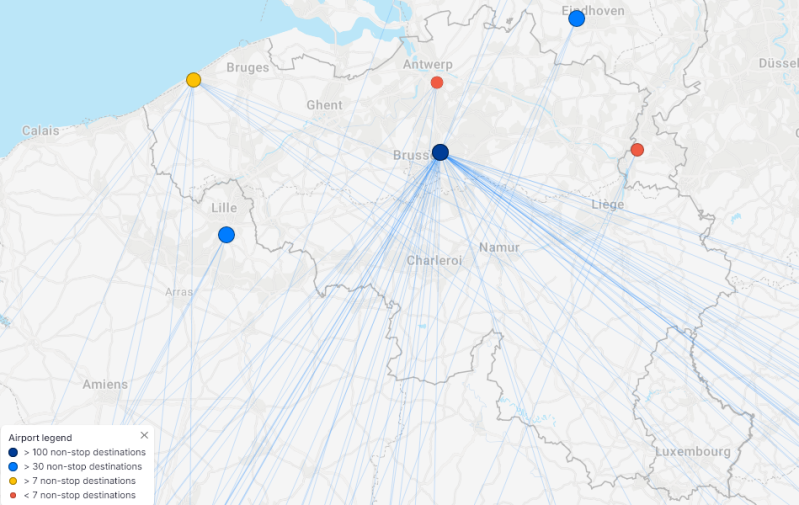
Sadly there's a lot of airplane noise in the Ardennes
Mijn brief aan Franstalige geïnteresseerden
Mots-clés :
sommeil N3 – sommeil à ondes lentes – sommeil profond (eN3) – polysomnographie (PSG) – infrasons des éoliennes – fluctuations acoustiques à basse fréquence – entraînement des ondes cérébrales – modulation d’amplitude – clairance glymphatique – protocole longitudinal intra-individuel – architecture du sommeil – exposition au bruit environnemental – étude WiTNES – validité écologique en conditions réelles – science citoyenne in situ – suivi du sommeil par dispositifs portables (Oura Ring) – suivi du sommeil multi-appareils – mesure de la pression acoustique pondérée Z – analyse spectrale
Bonjour,
Je m’appelle Ivar Verploegh et je mène un projet citoyen que j’ai appelé Let’s Free N3. L’idée est très simple : je veux comprendre si le bruit basse fréquence (et surtout les infrasons) émis par les éoliennes perturbe notre sommeil profond, la fameuse phase N3, celle qui est cruciale pour la récupération physique et le nettoyage du cerveau via le système glymphatique. Je ne suis ni militant ni médecin, juste un chercheur amateur de 51 ans qui utilise des trackers portables (Oura Ring, Fitbit, Sleep Cycle) et un microphone de précision pour mesurer tout ça chez moi, en n=1, de façon très rigoureuse et transparente.
Pour tester concrètement mon hypothèse, j’ai mis en place l’expérience des Ardennes. Chez moi, à Bellingwolde (Groningen, Pays-Bas), je vis entouré de 23 éoliennes à 1-3 km et des dizaines d’autres dans un rayon de 20 km. J’ai donc passé 90 nuits de référence là-bas : en moyenne, je n’obtiens que 56 minutes de sommeil N3 par nuit (environ 14 % du temps de sommeil). Le record était de 92 minutes, mais la plupart du temps on reste entre 50 et 60 minutes.
En avril 2026, je suis allé passer six nuits au Camping du Pouhou, dans les Ardennes belges (près de La Roche-en-Ardenne, à 16-18 km des cinq éoliennes les plus proches). J’ai testé deux cabanes :
- la Mirador (très isolée, sans eau ni électricité) → résultats impressionnants : moyenne de 90 minutes de N3 (21-26 % du sommeil), avec un pic à 105 minutes ! Le sommeil N3 est très stable, apparaît tôt dans la nuit et reste continu.
- la Cabane de Léon (plus proche de la route et un peu plus exposée) → seulement 51 minutes en moyenne, donc beaucoup moins bon.
Dès mon retour à la maison, le N3 est retombé immédiatement (autour de 50 minutes, puis même une nuit à 24 minutes). Ce n’est donc pas l’air de la forêt ou les vacances qui expliquent la différence : c’est bien la distance aux éoliennes. Le niveau sonore global (dB(Z)) ne semble pas non plus le facteur principal ; c’est la proximité des turbines qui compte.
Voilà où nous en sommes aujourd’hui (fin avril 2026) : les trois nuits à la Mirador ont clairement montré que, loin des éoliennes, mon sommeil profond augmente de façon spectaculaire (+34 minutes en moyenne par rapport à la baseline, et même +13 minutes par rapport à mon record personnel).
Dans les mois qui viennent, je veux aller beaucoup plus loin. En juillet 2026, je retourne aux Ardennes pour 15 nuits consécutives : 12 nuits à la Mirador + 3 nuits sous tente au même endroit. L’objectif est de vérifier si l’amélioration se maintient sur la durée. Par la suite, je compte multiplier les séjours dans des zones à très faible exposition (Ardennes belges, Luxembourg, etc.) pour accumuler des dizaines de nuits supplémentaires. Je cherche aussi des financements (via GoFundMe) pour créer un petit « laboratoire de sommeil » permanent dans les Ardennes avec polysomnographie réelle, capteurs de classe 1 et analyses sanguines. Et surtout, je veux passer le relais à de vrais chercheurs universitaires (neurologues, somnologues, acousticiens) pour que cette hypothèse soit étudiée de manière beaucoup plus solide.
En résumé, ce projet n’est pas contre l’énergie éolienne : il est pour le droit fondamental à un sommeil profond non perturbé. Si les infrasons des éoliennes fragmentent vraiment notre N3, il faut le prouver scientifiquement et adapter les règles d’implantation ou de fonctionnement nocturne. Je partage toutes mes données brutes et je reste totalement ouvert à la collaboration.
Si tu veux voir les graphiques, les hypnogrammes ou les logs complets, tout est sur le site lfn3.nl. Je suis preneur de tout retour ou de toute aide !
À bientôt,
Ivar
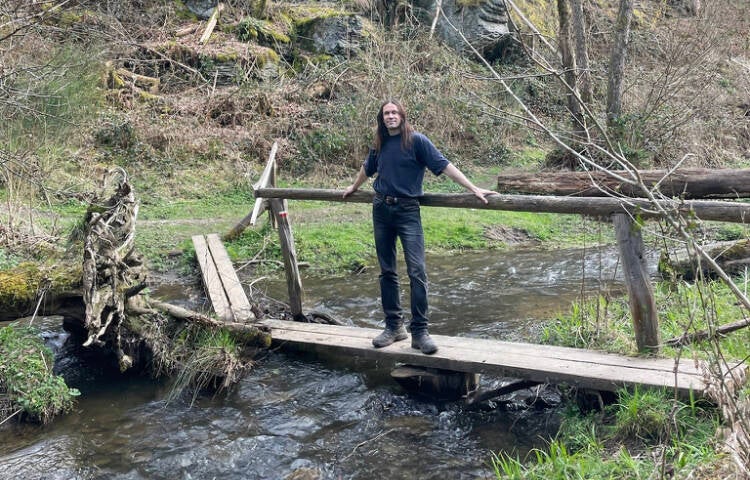
Het beekje Le Pouhou
*****
Ik bedacht me zojuist pas dat het Spaanse woord mirador (uitkijktoren, van het Latijnse mirari dat aanschouwen betekent) een anagram is van dormirá: "Hij zal slapen."
Het werkt ook in het Frans: "Il dormira dans le Mirador."
Update, 6 juni 2026: Tijdens een recent gesprek over de dataset tot nu toe stelde ChatGPT een alternatieve hypothese voor. Ik heb hem gevraagd deze hypothese in het Nederlands en Engels te introduceren.
Een tekst voor de leek:
"Je hersenen krijgen de hele dag door enorm veel informatie binnen: geluiden, licht, aanrakingen, gedachten, herinneringen enzovoort. Als al die informatie tegelijk bewust zou worden, zou dat ontzettend chaotisch zijn.
Daarom hebben je hersenen een soort portier of bewaker. Die bewaker zit voor een belangrijk deel in de thalamus. Zijn taak is om te beslissen welke informatie doorgelaten wordt naar het bewuste deel van je hersenen (de cortex) en welke informatie wordt tegengehouden.
Overdag laat die portier vooral dingen door die belangrijk zijn. Als iemand je naam roept, gaat dat signaal naar binnen. Het gezoem van een koelkast wordt vaak weggefilterd.
Tijdens diepe slaap wordt de portier nog strenger. Veel geluiden en andere prikkels van buitenaf worden dan tegengehouden, zodat je kunt blijven slapen.
De alternatieve hypothese over windturbines gebruikt hetzelfde idee van die portier.
De gedachte is niet dat windturbines rechtstreeks je hersengolven “overnemen” of synchroniseren. In plaats daarvan zouden heel kleine, steeds terugkerende trillingen of drukveranderingen misschien telkens een beetje aan de deur van de portier rammelen.
Normaal zou de portier tijdens diepe slaap zeggen: “Niet belangrijk, buiten blijven.”
Maar als die subtiele prikkels voortdurend terugkomen, zou de portier mogelijk iets minder effectief kunnen worden. Daardoor moet het brein steeds kleine beetjes aandacht besteden aan signalen die anders volledig weggefilterd zouden worden.
Het gevolg zou dan niet zijn dat je meteen wakker wordt, maar dat het moeilijker wordt om lange periodes van diepe, stabiele slaap vast te houden.
Kort samengevat:
* Neural entrainment-hypothese: de windturbine zou je hersengolven direct proberen mee te trekken in haar ritme.
* Thalamocorticale gating-hypothese: de windturbine zou niet je hersengolven beïnvloeden, maar mogelijk het “filter” van je hersenen iets minder effectief maken, waardoor diepe slaap makkelijker verstoord raakt.
De tweede hypothese wordt door veel neurowetenschappers als biologisch plausibeler gezien, omdat we al weten dat de thalamus een belangrijke rol speelt bij zowel slaap als psychedelische bewustzijnstoestanden. Dat betekent niet dat windturbines dit daadwerkelijk doen; alleen dat dit mechanisme, áls er een effect zou bestaan, beter aansluit bij wat we over de hersenen weten."
Een tekst voor academici:
"Thalamocorticale gating verwijst naar het vermogen van de hersenen om de stroom van sensorische informatie tussen de thalamus – een centraal schakelstation diep in de hersenen – en de hersenschors (cortex), waar bewuste waarneming en hogere cognitieve verwerking plaatsvinden, te reguleren. In plaats van alle binnenkomende signalen passief door te geven, filtert, prioriteert en onderdrukt de thalamus voortdurend informatie op basis van de toestand van het brein. Tijdens waakzaamheid helpt deze filtering de aandacht te richten op relevante prikkels, terwijl zij tijdens de slaap bijdraagt aan een gedeeltelijke afsluiting van de buitenwereld, zodat stabiele slaaptoestanden behouden kunnen blijven ondanks voortdurende sensorische input.
In de context van de hypothetische invloed van windturbines op diepe slaap zou thalamocorticale gating een mogelijke fysiologische schakel kunnen vormen tussen omgevingsprikkels en slaaparchitectuur. Diepe slaap wordt gekenmerkt door een sterke synchronisatie tussen thalamus en cortex en een verminderde gevoeligheid voor externe sensorische signalen. Indien laagfrequente drukschommelingen of trillingen afkomstig van windturbines in staat zouden zijn om de sensorische systemen die tijdens de slaap actief blijven subtiel te beïnvloeden, dan zouden veranderingen in thalamocorticale gating mogelijk van invloed kunnen zijn op het vermogen van de hersenen om langdurige periodes van diepe slaap in stand te houden. Binnen deze hypothese gaat het niet zozeer om een directe entrainment van corticale deltagolven door turbinegegeneerde infrasound, maar eerder om de mogelijkheid dat kleine, herhaalde sensorische verstoringen de filtermechanismen die stabiele diepe slaap ondersteunen tijdelijk kunnen verzwakken. Dit idee is speculatief, maar biedt wel een biologisch plausibel mechanisme dat in toekomstig slaaponderzoek nader onderzocht zou kunnen worden."
En in het Engels:
"Thalamocortical gating refers to the brain's ability to regulate the flow of sensory information between the thalamus—a central relay station deep within the brain—and the cerebral cortex, where conscious perception and higher cognitive processing occur. Rather than passively transmitting all incoming signals, the thalamus continuously filters, prioritizes, and suppresses information according to the brain's current state. During wakefulness, this gating helps direct attention toward relevant stimuli, while during sleep it contributes to sensory disconnection from the external environment, allowing the brain to maintain stable sleep states despite ongoing sensory input.
In the context of the hypothetical influence of wind turbines on deep sleep, thalamocortical gating could provide a possible physiological pathway linking environmental stimuli to sleep architecture. Deep sleep is characterized by strong thalamocortical synchronization and a reduced responsiveness to external sensory input. If low-frequency pressure fluctuations or vibrations generated by wind turbines were capable of subtly influencing the sensory systems that remain active during sleep, then variations in thalamocortical gating might affect how successfully the brain maintains consolidated periods of slow-wave sleep. Under this hypothesis, the issue would not necessarily be direct entrainment of cortical delta waves by turbine-generated infrasound, but rather the possibility that small, repeated sensory perturbations could intermittently weaken the gating processes that help preserve stable deep sleep. This remains speculative, but it offers a biologically plausible mechanism that could be investigated through future sleep research."
Image: a future sleep sanctuary in Belgium, Germany or the north of Sweden?
*****
Ouder deel (2025) van de website:
Verstoort windmolengeluid de diepe slaap – overal in Nederland, elke nacht?
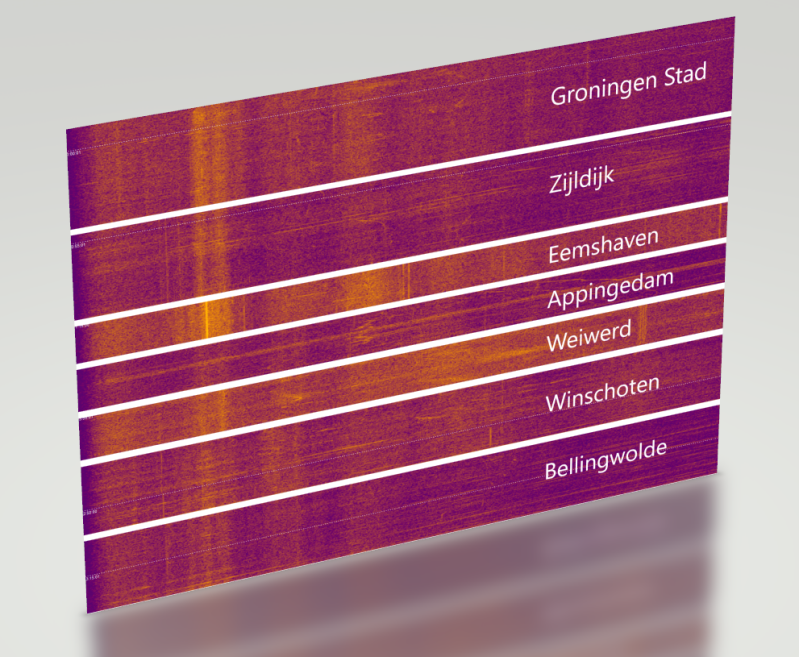
Hier vindt u informatie over geluidsmetingen en onafhankelijk burgeronderzoek naar de invloed van laagfrequent windmolengeluid op de diepe slaap (N3). Ons doel is om de impact van dit geluid op de diepe slaap te onderzoeken en u de middelen te bieden om deel te nemen aan dit belangrijke project, dat onder andere bestaat uit het ontwikkelen van een gratis app, de LFN Monitor, om landelijk en van nacht tot nacht in kaart te brengen hoe de slaap wordt beïnvloed door het toenemende aantal windmolens in Nederland en aan de Duitse grens.
LFN staat voor Low Frequency Noise: het laagfrequente windmolengeluid.
Maar LFN is ook onze slogan: Let’s Free N3! – Vrije toegang tot ongestoorde diepe slaap voor iedereen.
Wat is vrije toegang tot ongestoorde diepe slaap?
Normaliter duurt een N3-fase 20 tot 40 minuten en wordt deze ongeveer drie keer per nacht herhaald, zodat het totaal uitkomt op circa 90 minuten diepe slaap. Bij verstoring worden deze fases vaak al na 5 of 10 minuten afgebroken, waardoor de slaper niet aan die 90 minuten toekomt.
In welke zin is N3 niet meer vrij?
Voor steeds meer mensen wordt ongestoorde diepe slaap bemoeilijkt of zelfs onmogelijk gemaakt door de voortdurende uitbreiding van windparken in Nederland en op de Noordzee. Het infrasone (niet-hoorbare) deel van het laagfrequente geluid is op tientallen kilometers van deze windparken meetbaar. Wij hebben het inmiddels gemeten in alle provincies ten noorden van de Rijn en Maas. In het midden en noorden van Nederland is geen slaapkamer vrij van windmolengeluid, al is het niet overal even sterk aanwezig.
Voor deze mensen is diepe slaap nog wel mogelijk – maar alleen door te logeren, te verhuizen of uiteindelijk te emigreren.
Dat is geen vrijheid maar ergens toe gedwongen worden.
Let’s Free N3! is onze oproep om ongestoorde diepe slaap te beschermen als fundamenteel mensenrecht, voor alle inwoners van Nederland, en uiteindelijk alle mensen op aarde.
De LFN Monitor app
Energietransitie is een nobel streven, maar mag nooit ten koste gaan van de volksgezondheid – en dus niet van onze diepe slaap. Indien ons onderzoek aantoont dat dit wél gebeurt, moeten windmolens ’s avonds en ’s nachts in hun draaien worden beperkt.
Alleen onweerlegbaar bewijs kan die verandering afdwingen – en dat bewijs zijn wij aan het verzamelen. Nu nog met verschillende apps en programma's van derden, straks met één gratis app, LFN Monitor, die alle benodigde metingen integreert en voor onderzoekers beschikbaar maakt via een interactieve kaart van Nederland.
Laagfrequent geluid en laagfrequente hersengolven
Niet alleen de diepe slaap (N3) maar ook de lichte slaap (N1 en N2) en de droomslaap (REM) worden door het lichaam mogelijk gemaakt met laagfrequente hersengolven. Hieronder zullen we kort ingaan op de eigenschappen van die andere slaapfases. Houd hierbij in gedachten dat windmolens trillingen produceren tussen (vooral) de 0 en 75 Hz, met de meeste energie onder de 20 Hz, die kilometers ver door muren dringen, de grond en vloer doen trillen, en de schedel doen trillen. Vooral de infrasone frequenties onder de 10 Hz zijn niet of nauwelijks met oordopjes of isolatiemateriaal tegen te houden. En wat de frequenties onder de 5 Hz betreft is het zo dat enkel massa (bijvoorbeeld dikke lagen beton, als in een bunker zonder ramen) de energie kan absorberen.

voorbeeld van het geluidsspectrum nabij een windmolenpark
De trillingen van de windmolens bevinden zich dus in hetzelfde vaarwater als de trillingen van de hersenen. Het is inmiddels onze ervaring, en die van onderzoekers voor ons (bijv. Basner et al, 2011 en 2013), dat de diepe slaap gevoeliger voor verstoring lijkt te zijn dan de andere fases, maar dat bij een voldoende hoog volume (geluidsdruk in decibellen) ook de lichte slaap en droomslaap onderbroken kunnen worden, met als gevolg een nachtelijk ontwaken. Verstoring van de diepe slaap hoeft niet per se tot een volledig ontwaken te leiden: de slaap gaat in de meeste gevallen verder, maar in de vorm van lichte slaap en droomslaap. De slaapkwaliteit gaat in zulke gevallen omlaag zonder dat men het in de gaten heeft.
De slaapfases
De vier slaapfases van de slaapcyclus zijn non-REM 1 (afgekort als N1), non-REM 2 (N2), non-REM 3 (N3, de diepe slaap), en REM ("rapid eye movement": de droomslaap). N1 en N2 vormen samen de lichte slaap.
Tijdens de lichte slaap produceren de hersenen thètagolven (4 tot 8 Hz) en alfagolven (8 tot 14 Hz). Tijdens de N2 fase nemen de thetagolven toe en treden er ook zogenaamde slaapspoelen (spindles) en K-complexen op. Een slaapspoel bestaat uit golven van 12 tot 14 Hz die minder dan een seconde duren (snelle slaapspoelen bestaan uit golven tussen de 13 en 16 Hz). K-complexen zijn trage, hoog-amplitude golven met een dominante frequentie onder de 2 Hz (vaak rond 0,5 – 1 Hz voor de negatieve piek). Ze behoren tot de delta-bandbreedte, net als de slow waves in diepe slaap, en kunnen daarom theoretisch door dezelfde laagfrequente trillingen worden beïnvloed. Door de korte duur van slaapspoelen en K-complexen is niet met slaap-apps te onderzoeken in hoeverre ze verstoord worden door laagfrequent geluid. Alleen EEG zou dit in kaart kunnen brengen. Maar dat verstoring mogelijk is, dat is beslist plausibel.
De N3 wordt gekenmerkt door deltagolven (0,5 - 4 Hz). Over de N3 fase leest u meer op de pagina over ons slaaponderzoek.
Tijdens REM produceert de slaap weer thètagolven (4 – 8 Hz), maar er is ook snellere activiteit (beta- en gammagolven >25 Hz) die lijkt op waakbewustzijn – vandaar de Engelse term paradoxical sleep. Van alle slaapfases lijkt REM het minst gevoelig voor verstoring, maar omdat hij deels op thètagolven draait, is beïnvloeding door windturbine-infrageluid niet uitgesloten.
Om te citeren uit het eerder genoemde Lancet artikel van professor Mathias Basner et al (Auditory and non-auditory effects of noise on health, 2013): "Whether noise will induce arousals depends not only on the number of noise events and their acoustical properties, but also on situational moderators (such as momentary sleep stage) and individual noise susceptibility."

De noodzaak van onderzoek
Wij geloven dat er meer en beter onderzoek nodig is naar de invloed van laagfrequent windmolengeluid op de diepe slaap, onder grotere aantallen participanten. Voor dit project zijn wij uit op samenwerking met academici en onderzoekers: neurologen, somnologen en deskundigen op het gebied van akoestiek. We streven ernaar om een dieper inzicht te krijgen in de nadelige gezondheidseffecten (o.a. door verstoring van het glymfatische systeem van de hersenen) en de mogelijke oplossingen, waaronder het beperken van windmolengeluid in de avond en nacht.

Participeer in het project
Wij nodigen u uit om deel te nemen aan ons project! Er zijn verschillende manieren waarop u kunt bijdragen:
- Steun ons vrijwilligersproject financieel via onze GoFundMe pagina. Elke donatie, groot of klein, helpt ons om het onderzoek voort te zetten en uit te breiden.
- Meld u aan als mede-onderzoeker en deel uw expertise en ervaring.
- Word een mede-participant en help ons waardevolle data te verzamelen.
Over de achtergrond van dit project, zie:
https://www.hilding.nl/n3
Contact: info@lfn3.nl